
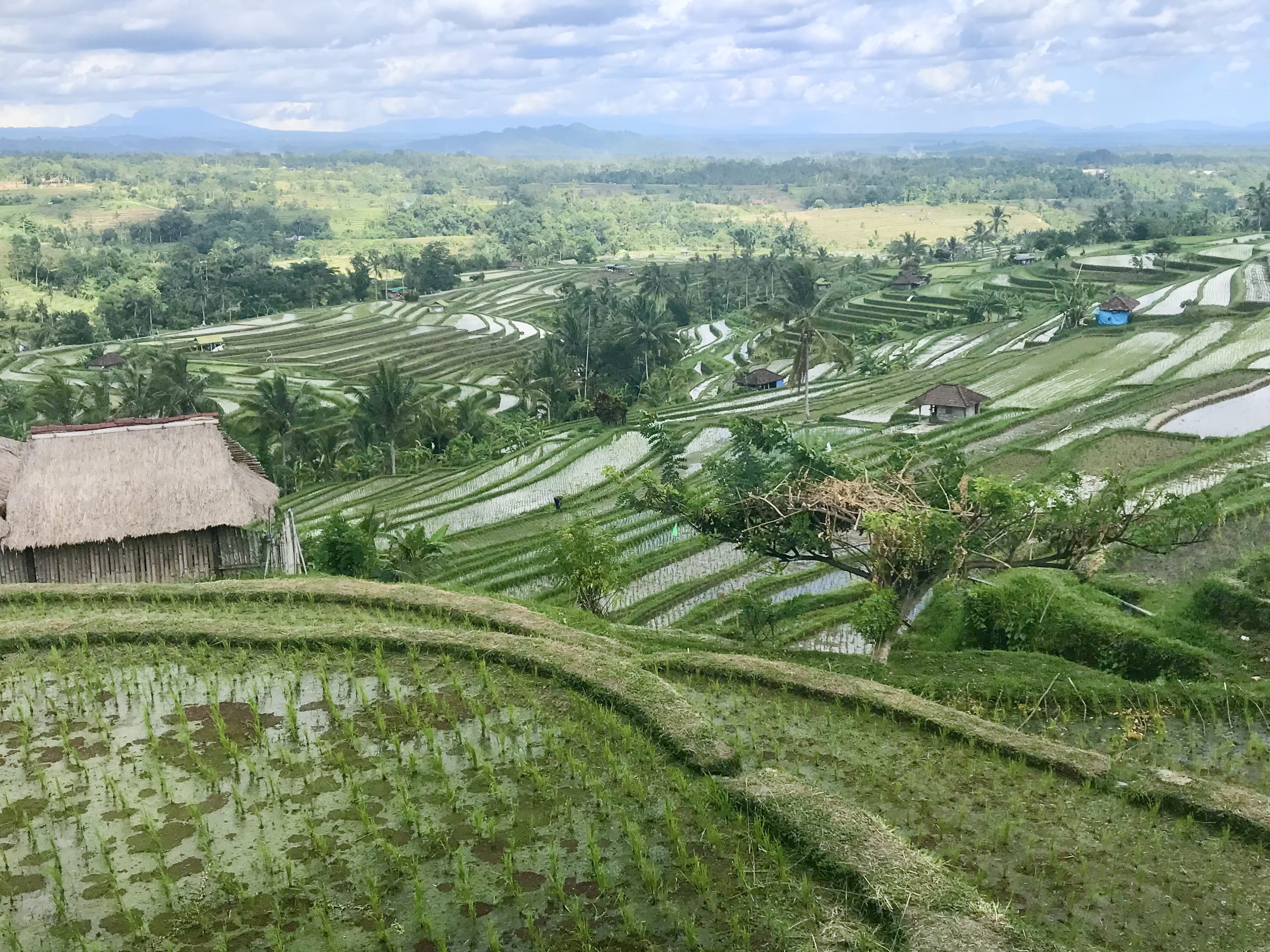
In 2016, as part of a panel in the Ubud Readers and Writers Festival the following statement was put to us:
Bali is a place that knows how to adapt
Our task was to explore this proposition.
My thoughts
Though I could see many problems in the way Bali was approaching tourism I was perhaps a little more confident that the more deleterious impacts of tourism would be confined to the southern areas and perhaps in the Gianyar region and that, driven by the strong culture of that region, a more environmentally sensitive form of tourism could be developed.
Know I realise that I was being far too optimistic.
Exploring the matter more deeply I offer the following thoughts.
What is adaptation
In biology – the process of change by which an organism or species becomes better suited to its environment. In an evolutionary sense predicated on the existence of natural selection.
In a social sense: the process of changing to better suit a situation.
Now that makes sense Desa, Pala, Patra – adapting to time, place and context, is a commonly understood principle in Bali and therefor a potential strength.
There is no doubt that the connectivity and creativity of Balinese society affords a degree of resilience in the fast of major changes offering many opportunities for social adaptation, many creative solutions. Indeed, the early emergence of cultural tourism in the Gianyar Regency, Ubud appeared to demonstrate a positive adaptation. This was supported by institutions such as the Puri Lukisan and organisations like Bina Wisata
In the period following the tragic Bali Bombings of 2002 the Ubud Writers and Readers Festival, established in 2004, clearly added value to tourism, strengthened local capacities to creatively respond, and adapt, to a changing world, one globalised industry and an emerging post-industrial economic system.
Where I questioned Bali’s adaptability was in the domain of the biophysical environment, it’s management, and the associated environmental economics, or the green economy. Here the answer to the question was most problematic. I contended that Bali isn’t successfully adapting in this domain, but retain a significant degree of optimism, given the creativity of the human resources on this small island.
I continue to shape my answer to this question from spiritual, scientific and economic perspectives.
A spiritual perspective
Spiritually my position is in accord with the His All-Holiness Ecumenical Patriarch Bartholomew
If human beings treated one another’s personal property the way they treat their environment, we would view that behavior as anti-social. We would impose the judicial measures necessary to restore wrongly appropriated personal possessions. It is therefore appropriate, for us to seek ethical, legal recourse where possible, in matters of ecological crimes.
It follows that, to commit a crime against the natural world, is a sin. For humans to cause species to become extinct and to destroy the biological diversity of God’s creation… for humans to degrade the integrity of Earth by causing changes in its climate, by stripping the Earth of its natural forests, or destroying its wetlands… for humans to injure other humans with disease… for humans to contaminate the Earth’s waters, its land, its air, and its life, with poisonous substances… these are sins.
Orthodox Churches Statement on the Environment
Elsewhere the Patriarch explained that the way “. . . we treat the earth and all of creation defines the relationship that each of us has with God. It is also a barometer of how we view one another.”
Tri Hita Karana
When I first came to Bali, I hadn’t developed such insights, I brought my background in Geography and Economics, but it wasn’t long before I came up against a Balinese spiritual tool Tri Hita Karana.
In simple terms it asserts that there are three causes of prosperity and happiness and that these proceed from harmonious relationships between:
(1) Humans and God – Parhyangan;
(2) Humans and their neighbours – Pawongan,
(3) Humans and the natural world – Palemahan.
Its roots are far more ancient, although this doctrine was only widely propagated in Bali as recently as the 1966. My sense was that Tri Hita Karana could be applied in a material as well as a spiritual way yet I saw many examples of lack a of material harmony or equilibrium, particularly in the relationship between humans and nature.
What I wasn’t understanding was the application of another set of understandings
Sekala and Nislala. In the simplest sense this means that reality, is an interaction of the Seen and the Unseen. In time I came to accept this idea and have now completed my first book of short stories with this as the part of its title.
Yet in accepting this idea it gradually became plain that harmonious relations between humans and nature were often mediated through ceremonies, through the Unseen realm and that for many this represented sufficient regard for the environment.
This worked well enough in the pre-industrial world even though Bali was by no means sealed and impervious to outside influences. Fortunately, for the most part, such external influences were not environmentally disruptive, by comparison with the present.
The Growth of Wide Bodied Jet Travel
Things changed in the 1970s with the growth is wide bodied jet travel and the dawn of the era of mass tourism.
Before this era forces like Bhoma played their part within the unseen realm.
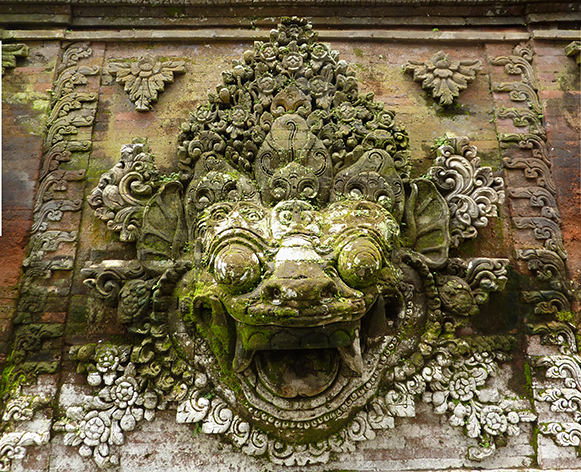
The child of Vishnu and Ibu Pertiwi (Mother Earth), Bhoma is an entity intrinsically connected with the conjunction of earth and water. In terrestrial environments, earth, water, atmosphere and biosphere all meet. All four domains are present in a space where energy is exchanged and fundamental transformations in states of matter occur.
In pre-industrial Bali it was easy for humans, much of what they did was in harmony with nature, so natural processes remained intact and unimpeded. All remained in equilibrium and Bhoma was free to carry out his work skimming across the earth and transforming rubbish into the food of life.
Where are we now?
Bhoma has indigestion, the heartburn of Tri Hita Karana.
The Bali I encountered, when I first visited has gone.


My greatest fear is that given the high demand elasticity of budget tourism in Southeast Asia, and the mounting numbers of tourists escaping polluted and turbulent that they will settle for tarmac, concrete and plastic, an artificial and unsustainable paradise.
The solution is in valued added tourism. I’ve always believed that cultural, environmental and educational tourism is something Balinese society can do well.
When I wrote what precedes this, I thought there was a chance the Provincial Government of Bali’s Clean and Green Program (2011) might strengthen sustainable tourism strategies.
Its mission was:
- Increasing awareness and concern of society in environmental conservation area Bali;
- Realising economic development and environmental sustainability
- Creating a clean environment healthy comfortable, sustainable and beautiful
I was hopeful that Bali might still be the morning of the world, even if it was moving towards midday – siang.
Needless to say, the Clean and Green Program was of limited effect. Bali continues to struggle with the impact of over development. Increased and rapid growth of tourism continues leading to:
- sustained environmental degradation
- loss of agricultural land and
- placed significant strain on the island’s infrastructure.
An example of unsympathetic development
Indonesian ministers are drafting legislation to include these measures measures:
- Moratorium on New Developments: A ban on constructing new hotels, villas, and nightclubs in heavily trafficked areas like Denpasar, Badung, Gianyar, and Tabanan has been introduced.
- Tourism Tax: A new tax of 150,000 rupiah for foreign visitors to fund improvements in infrastructure, waste management, and public transport.
- Legislation to Protect Agricultural Land: Policies to prevent the conversion of agricultural land into commercial spaces, in an attempt to protect the island’s agricultural heritage.
- Sustainability Initiatives: Further efforts to improve management of waste, and measures to ensure sustainable water consumption.
 Maximos' Blog
Leave a comment