Today I spent hours scanning both old colour and also black and white negative film,. All from the period when I was a director of Asian Field Study Centres, a company that operated a program of field study across Indonesia. Most clients were secondary school students from Australia but extended both into primary schools and other educational institutions from New Zealand and the USA.
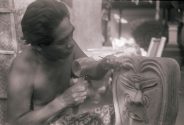
Flicking through hundreds of frames, I was struck by these images of Wayan Cemul.


Beyond the Geomorphic: Inspiration for the Story
In my recent book of short stories, Beyond Borders: conversations across boundaries I wrote a story titled Beyond the geomorphic. My inspiration arose when one day I noticed excavations on a building site below my apartment were beginning to reveal a grey substance. I recognised the material as weathered volcanic sandstone, something I’d often seen in Bali where it is used for carving.
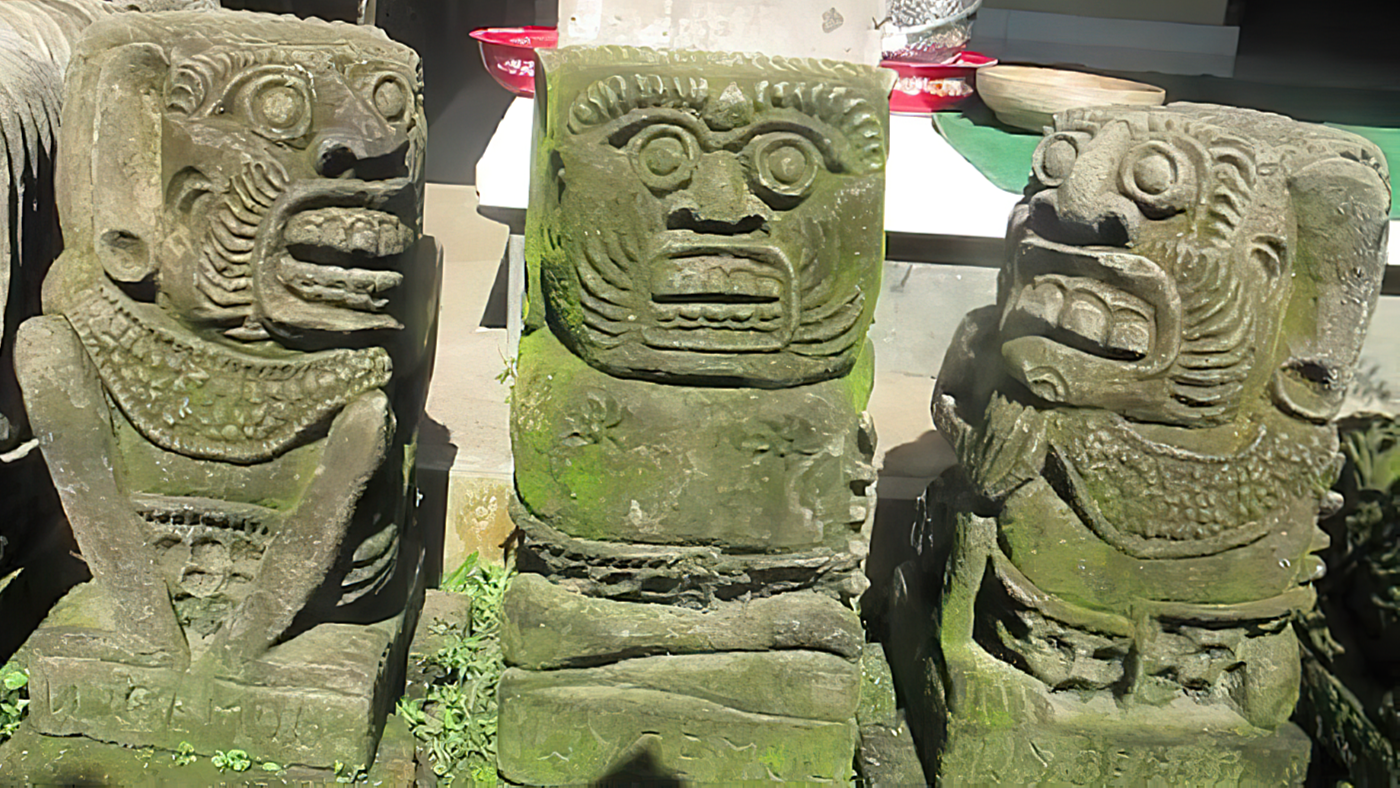
Wayan Cemul was a prolific stone carver, and a man of singular patience. His carving was unique, sometimes described as having a ‘primitive’ style his carving was outside the more traditional forms of Indic Balinese stone carving, rough strong and expressive. In sense he was a Balinese Outsider Artist.
Cemul was an outstanding teacher. Completely dedicated to his craft, original, patient and skilled in handling difficult students. He did all with barely any English, and rudimentary Bahasa Indonesia. A master of non-verbal communication. Students consistently rated him as the best in evaluations.
Visiting him at the beginning of each field study season he would remind me of his pedagogical principles. Taking a block of tuff, he reached for a stick of carbon, the centre of an old D Cell battery. Using it as a marker he sketched a centre line down its face, a longitudinal bisection. Next he chiselled one side, the students the other copying his moves and chisel positions.
Holding piece of tuff, he would say, “Saya gambar segini – I draw this way
Handing the rock over he would say, “Ok you,” gesturing for me to complete the sketch by scribing the mirror image.
Picking up his chisel, a simple device made from an old car spring, he would begin chiselling from the line outwards.
Holding the bevelled part of the chisel away from the line he would feign a mallet strike and say, “Bukan segini (Not this way).
Rotating the chisel so the bevelled side faced the line he would say, Segini (This way), as he struck the chisel and pared away a chunk of tuff.
When I last spoke with him, he no longer remembered much of the past. Though I felt the loss, his death in 2012 came as no surprise.
I miss him.
beyond the geomorphic: The Story
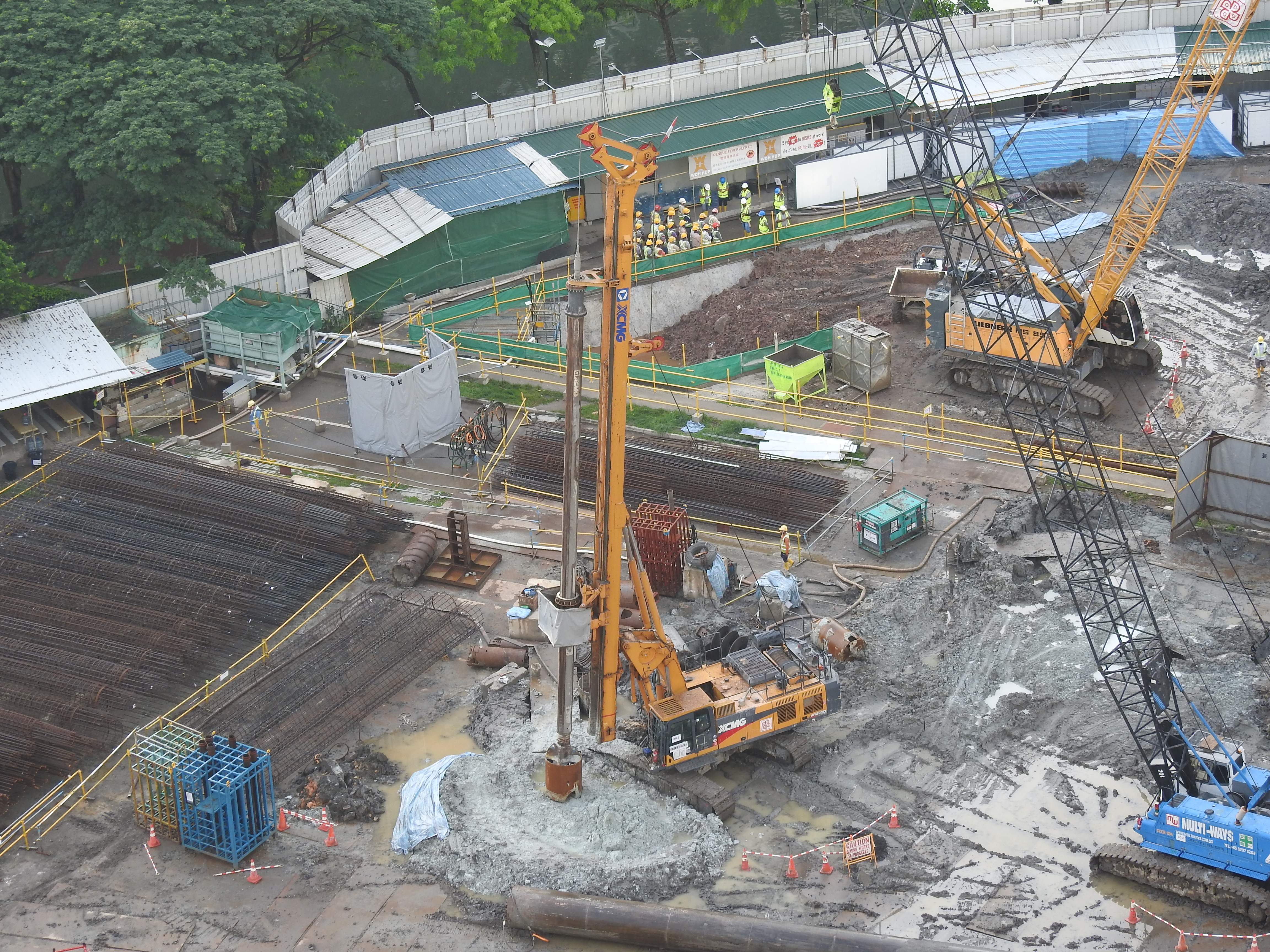
From the 19th floor of the Singapore apartment site preparation was easy to observe. Over several weeks the land around three heritage listed godown was transformed. A parking lot was cleared, trees felled, curbs and gutters jack hammered up, construction huts erected, temporary site drainage arranged, lighting, and generators installed. Once complete cranes and boring equipment were moved on site, and the slow task of sinking footing shafts begun.
Close to the river the bores yielded alluvial deposits then clay. Those further from the banks brought forth thinner alluvial material, shale like dry clay, and eventually a soft light grey rock. This was a moment of surprise, an encounter with the familiar, and the ancient. Hewn from Balinese river valleys such grey rock is used in carving a pantheon of religious objects, decorative landscaping features and tourist souvenirs.
To an eye familiar with the geology and geomorphology of Sunda[1] it is instantly recognisable as tuff, a volcanic sandstone. In Bali swift rivers carved a radial system of ridges and valleys, deep into its layers. Yet its sighting yielded memories beyond such geomorphic concerns.
Wayan Cemul was a stone carver from Ubud, a man of singular patience. His carving was unique, sometimes described as having a ‘primitive’ style his carving was outside the more traditional forms of Indic Balinese stone carving, rough strong and expressive. In sense he was a Balinese Outsider Artist.
Unknown to me at first it was only when a friend, Madeleine Murray suggested that I enlist his help with a field study programs I was managing, that our relationship began. She’d done a stone carving course with him one year earlier and returned with her son, so that he too might learn something of the stone carvers’ art.
Piles of tuff accumulating on the building site below prompted me to call her.
“In those days, Ubud was a couple of dirt roads, with paths leading off.
The paths were bordered by flower hedges, and family ‘compounds’ with carved statues flanking the gates,” she recalled.
“There is still some of that, though when I was last near Cemul’s place a Coca Cola delivery van blocked the lane. Progress eh?”
“It was very exciting to be welcomed into his compound. He greeted me and took me to an open room with a dirt floor and thatched roof. He wore a sarong and always looked strong, healthy and friendly.”
“Yes, always so friendly.”
“We would sit on a mat, and I would carve the block of soft grey
river sandstone he gave me. He helped me sketch out an idea and make something three-dimensional. He showed me how to use the tools and to make something pleasing. I ended up carving a face, about 30cm high. I kept it in my garden for years, then someone stole it.”
“Strange, the same sort of thing happened to me but that’s another story.”
Cemul was an outstanding teacher. Completely dedicated to his craft, original, patient and skilled in handling difficult students. He did all with barely any English, and rudimentary Bahasa Indonesia. A master of non-verbal communication. Students consistently rated him as the best in evaluations.
Visiting him at the beginning of each field study season he would remind me of his pedagogical principles. Taking a block of tuff, he reached for a stick of carbon, the centre of an old D Cell battery. Using it as a marker he sketched a centre line down its face, a longitudinal bisection. Next he chiselled one side, the students the other copying his moves and chisel positions.
Holding piece of tuff, he would say, “Saya gambar segini – I draw this way
Handing the rock over he would say, “Ok you,” gesturing for me to complete the sketch by scribing the mirror image.
Picking up his chisel, a simple device made from an old car spring, he would begin chiselling from the line outwards.
Holding the bevelled part of the chisel away from the line he would feign a mallet strike and say, “Bukan segini (Not this way).

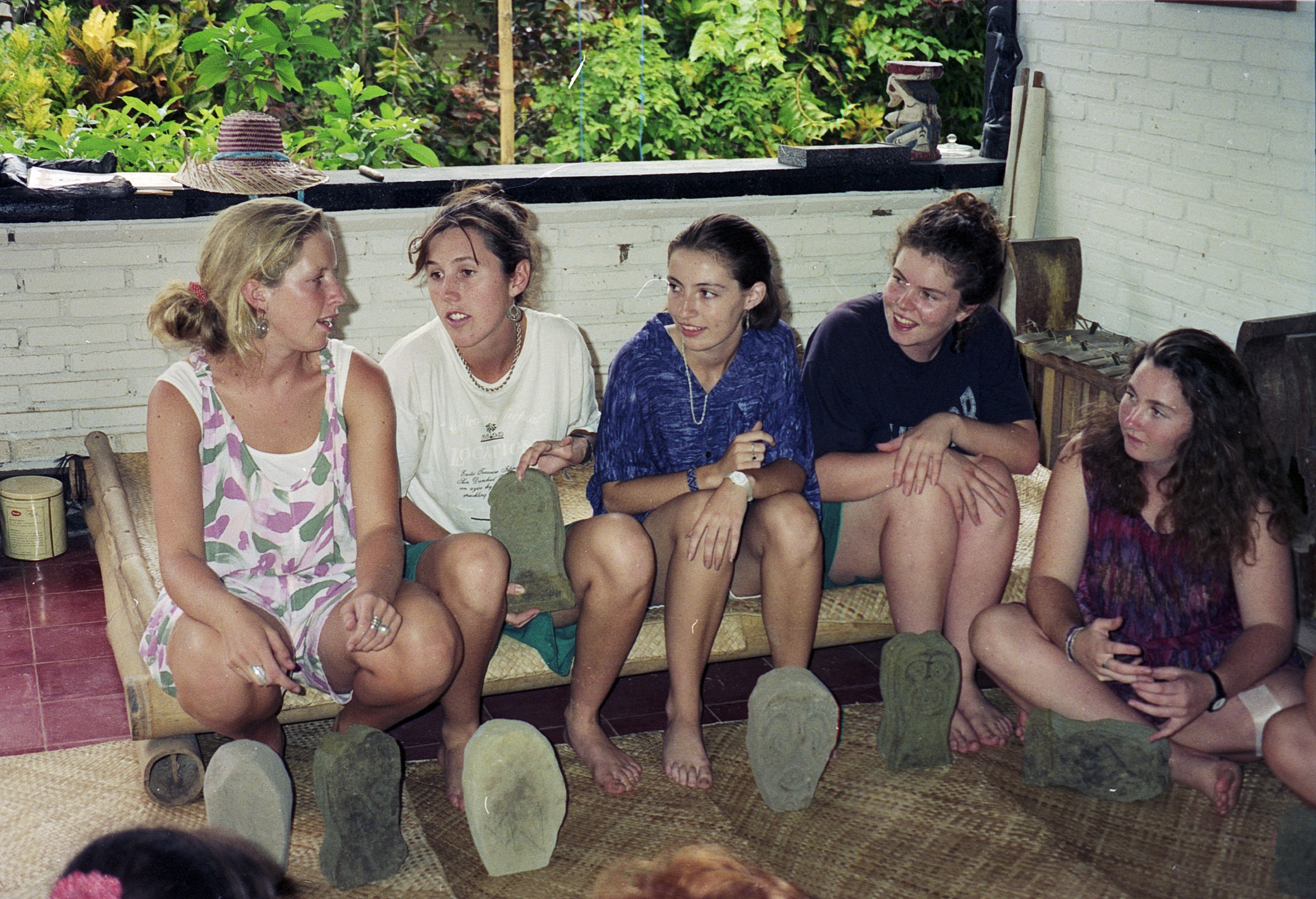
Rotating the chisel so the beveled side faced the line he would say, Segini (This way), as he struck the chisel and pared away a chunk of tuff.
When I last spoke with him, he no longer remembered much of the past. Though I felt the loss, his death in 2012 came as no surprise.
Noise of the drilling below reached a discordant climax. With three rigs operating at once it was difficult to concentrate. When an augur full of debris reached the surface, its contents was spun off. This wasn’t a smooth rotation, but a stop start action, producing a series of overlapping percussive rattles. Time to retreat to, Great World City, the mall across the river.
Crossing the sluggish river, realm of carp, loaches, catfish and most prominent of all turtles, evoked nostalgic memories of Bali’s mountain streams cascading through canyons of tuff, their steep sides embellished with garlands of ficus roots and hanging vines.
The Made Wijaya[2] wrote more about Cemul than most, concluding with his eulogy, published in the Bali Advertiser. He told a story of Cemul as a young working in the house of Dutch painter Rudolf Bonnet, as a gardener. There is a beautiful drawing by Bonnet of Cemul as a young man as a legacy of this period. Little known is a bas relief carving on a hill opposite Hotel Campuan, near Bonnet’s old house. Here Cemul’s profile is unmistakable.
Cemul’s cutting and chiselling of paras, the local name for tuff, began in those days through his association with Bonnet.
Some years later film maker, John Darling, rediscovered him and his unique carving style. John encouraged Cemul to begin making more functional art like carved wall panels and planters.
Cemul liked to tell a story about his Australian visit. He went for an exhibition in Canberra. There he had the pleasure of working with uncommon Australian tuff. Did he wonder where it came from? Was he puzzled by its very existence in a land so devoid of the tectonic dynamism? Perhaps someone told him about Australian hotspot volcanoes and even took him on a drive to the Monaro south of Canberra, where he could have seen remnant volcanic landscapes. He didn’t ever say and I forgot to ask. His strongest memory was how cold the weather was and how tough it was to carve Hawkesbury Sandstone.
During his visit, artists Ian and Laura Van Wieringen invited Cemul to stay with them at Whale Beach, north of Sydney. Here the coastline has thrusting headlands of Hawkesbury Sandstone. A 200-million-year-old Triassic rock comprises quartz mainly with a little feldspar, clay, and iron compounds.
‘Sangat keras batu itu,’ he said, recalling how hard it was to work with after tuff.
“He found the rock around the property in Whale Beach,” Laura explained. “It was local sandstone.”
So, it wasn’t neatly quarried blocks. “Did he work it with those light Balinese chisels?”
“Yes, he had his own chisels. He worked with the vein in the rock, of course this work was less detailed than Bali pieces.”
“It must have been difficult for him to carve, slower and noisier to work with as well.”
“He was very considerate. As he was up at dawn, he went to the top of the driveway to carve so he didn’t wake us up.”
“That’s the Wayan Cemul I knew. Such a good man.”
Singapore tuff, at least what was coming up from 25 metres below the surface, was hardly fit for working. Cemul would have puzzled over it, deeply buried under alluvium and clay as it was. He would not have been alone in this quandry, but the answer is simple. About 75,000 years ago on the nearby Sumatra island Mount Toba erupted, ejecting 1000 cubic km of tephra in the first nine days of its eruption, and 1000 cubic km more[3] over the ensuing year.
Toba’s eruption had planetary consequences triggering a volcanic winter, the Pleistocene Ice Age, and burying vast areas, along with their emerging megalithic cultures, under hundreds of metres of tephra. Sea levels fell as far as 150 metres. This probably explained the tuff at the bottom of the hole, but would Cemul be interested?
For Cemul the island of Bali rested on a stone plate, set on the back of Bedawang the earth turtle with two naga entwined around Bedawang. Tasked with restricting Bedawang’s movement they kept the island stable. Sometimes the naga slept and Bedawang was free to move with serious consequences for the island’s stability
A group of turtles sunned themselves on margins of the river, others drifted close to the surface. Great World City sits close to the river. Entering its powerful air conditioning system and chilled atmosphere closed out thoughts of Cemul and drew all into the present, save one lingering notion. Here beneath this world ran underground passages and tunnels of the soon to be commissioned Great World MRT Station. I toyed with the notion a large turtle supporting all.
A pop-up book stall loomed, dead ahead. Appearing every few weeks with remaindered editions it carried some unusual books at times. Caught in a will I, or won’t I, space. l succumbed.
“Do you have any history books,” I asked a young man organising and tidying books.
“Over there,” he pointed
“Are they together?”
“No, sprinkled through,” he added.
No history books in sight, yet moments later I was holding a copy of Made Wijaya’s, Architecture of Bali: A source book of traditional and modern forms. Flipping open the index it was a delight to see five references to Cemul’s carving.
Presenting the book to the cashier, I said, “I often admired his work in Bali, yet never managed to meet him. Quite a valuable book, of course more valuable if he’d signed it.”
“You’ve seen his work firsthand?” She asked.
“Often.”
“Maybe you could look him up and ask for his signature.” “I would if I could. Sadly, Made Wijaya left us three years ago.”
[1] Sunda is a biogeographic region comprising the Malay Peninsula and the Indonesian Archipelago west of the Wallace Line,
[2] Michael White, who changed his name to Made Wijaya, was an Australian architect of syncretic talent, one who brought so much of the architectural elements of Javanese and Balinese design into the present.
[3] Whitten, A.J et al. The Ecology of Sumatra. Gadjah Mada University Press. Yogyakarta 1987. P. 9
My entire work is best appreciated in multimedia format, as an Apple Book


 Maximos' Blog
Leave a reply to maximos62 Cancel reply