Jakarta is by no means the world’s most beautiful city, far from it. In places it’s a disturbing clutter of the informal, the speculative and the poorly built. Things have improved, it’s now difficult to find the crude plastic and packing cases structures, sometimes cantilevered over canals, that I first encountered here in the 1980s. As one long term Jakarta resident once said to me, Jakarta is an accumulation of humble village structures built by people from small villages all over Java. I don’t think he was entirely right. Certainly the boom years of the 80s and 90s saw the development of some highly functional contemporary architecture, but this was mainly confined to commercial and government projects. Housing in Jakarta, on the other hand, often confirms my colleagues observations.
There are some fine gated communities, some of the latest I noticed were advertised in the Garuda in flight magazine. These elegant, architect designed precincts are excellent contemporary examples of urban design. There are also some fine suburbs where the monied, both old and new, have built leafy pleasant environments. Menteng is one of these, traditionally a wealthy part of Jakarta it was where the former President Suharto lived along with many of his Ministers and his extended family. Menteng was also where the young Barack Obama stayed during his 1967 Jakartan sojourn at the very beginning of Suharto’s New Order period.
Presently I’m staying on the edge of Menteng in an area of typical inner city clutter known as Kebon Sirih. Here the forces of urban decay and renewal are everywhere. Urban renewal is on a far more modest scale than urban decay and everywhere one encounters the heterogeneity that’s such a feature of Asian cities. Looking out my hotel window the first thing I noticed was the collapsing corrugated asbestos roof two doors away. I’m glad it’s the wet season, it keeps the dust settled.
Here in this small area the full impact of Indonesia’s economic transition from the days of Suharto’s New Order, through the Asian and more recent Global Economic Crises, is plain to see. My favourite hotel in the area, the Sabang Metropolitan, has been gutted, everything of value stripped from it. Gazing over the corrugated iron fence it was hard to imagine its heydays
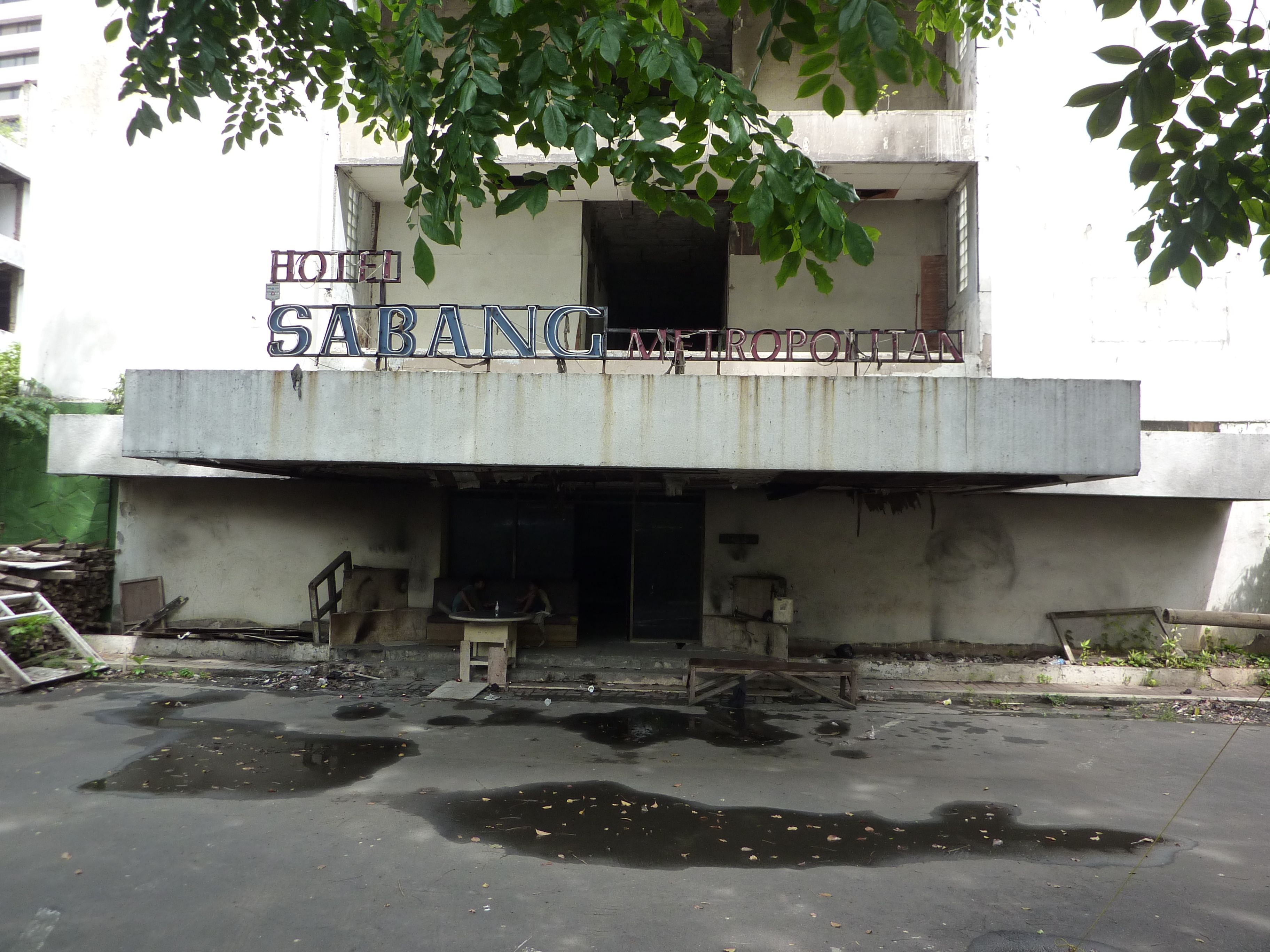
Eerily it stood, in places plants beginning to colonise it.
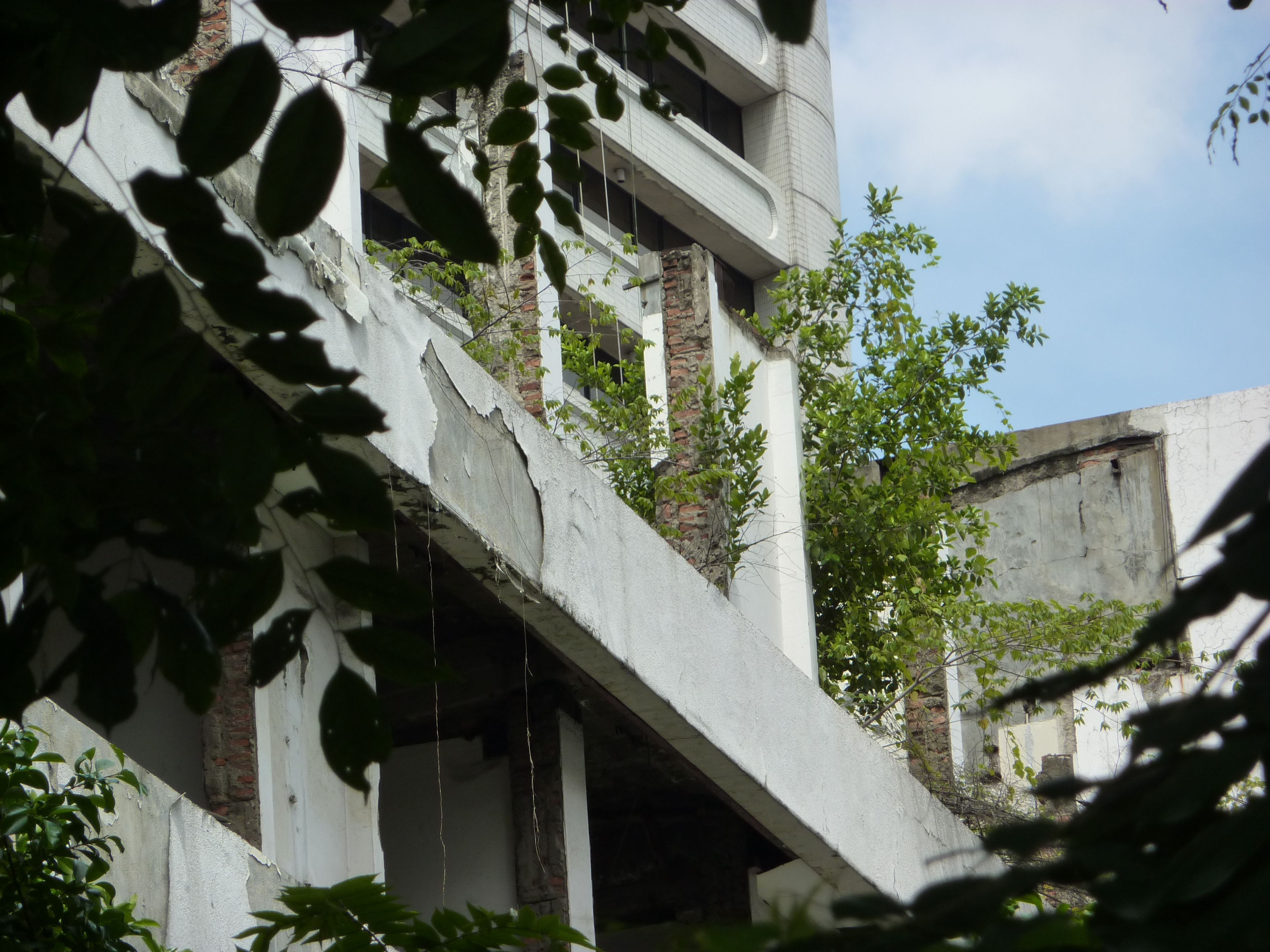
A popular resting place for government officials and business people it boasted excellent breakfasts and spacious lounges, ideal for informal meetings. Once it had been a lively centre of commerce and government business. Now the only commerce on the site is the Warung Nasi that stands outside on the footpath. This explains why they never answered my telephone calls from Australia.

Although the Hotel was on Jalan H. Agus Salim, the street is also known as Jalan Sabang and this is the local name for the busy collection of shops and restaurants along this strip, set between Medan Selatan on the edge of the National Monument and wealthy Menteng.
It’s a busy retail and restaurant precinct driven by it’s proximity to office buildings that line Jalan Thamrim, one of Jakarta’s main streets, just a block to the west on It’s also close to the Sarinah Department store, a Jakarta landmark, originally owned by Suharto’s family and now a state owned enterprise. It’s one of the oldest department stores in Jakarta, on the corner of ll. KH. Wahid Hasyim and Jl Thamrin.
Some of my favourite places have endured, there’s Sri Vishnu the Indian Tailors where it’s still possible to pick up three pairs of tailor made trousers for under $150. Across the road I was relieved that the Padang Restaurant Sederhana was also still operating and the standard of the food was still high. While far from the best Padang restaurant I’ve visited, the service is excellent and the food adequate.
After an evening meal at the Sederhana I was keen on something different for breakfast. Nasi Padang for three meals a day takes some getting used to. I’ve certainly done it in the past, but this is my first visit to Jakarta since 1999, so I’m out of training. As I ambled through Sabang, I almost failed to notice what turned out to be a most surprising coffee shop. Called Kopi Tiam Oey it’s the project of Bondan Winarno ,an Indonesian writer, publisher and former presenter on Indonesia’s Trans TV (Transformation TV)
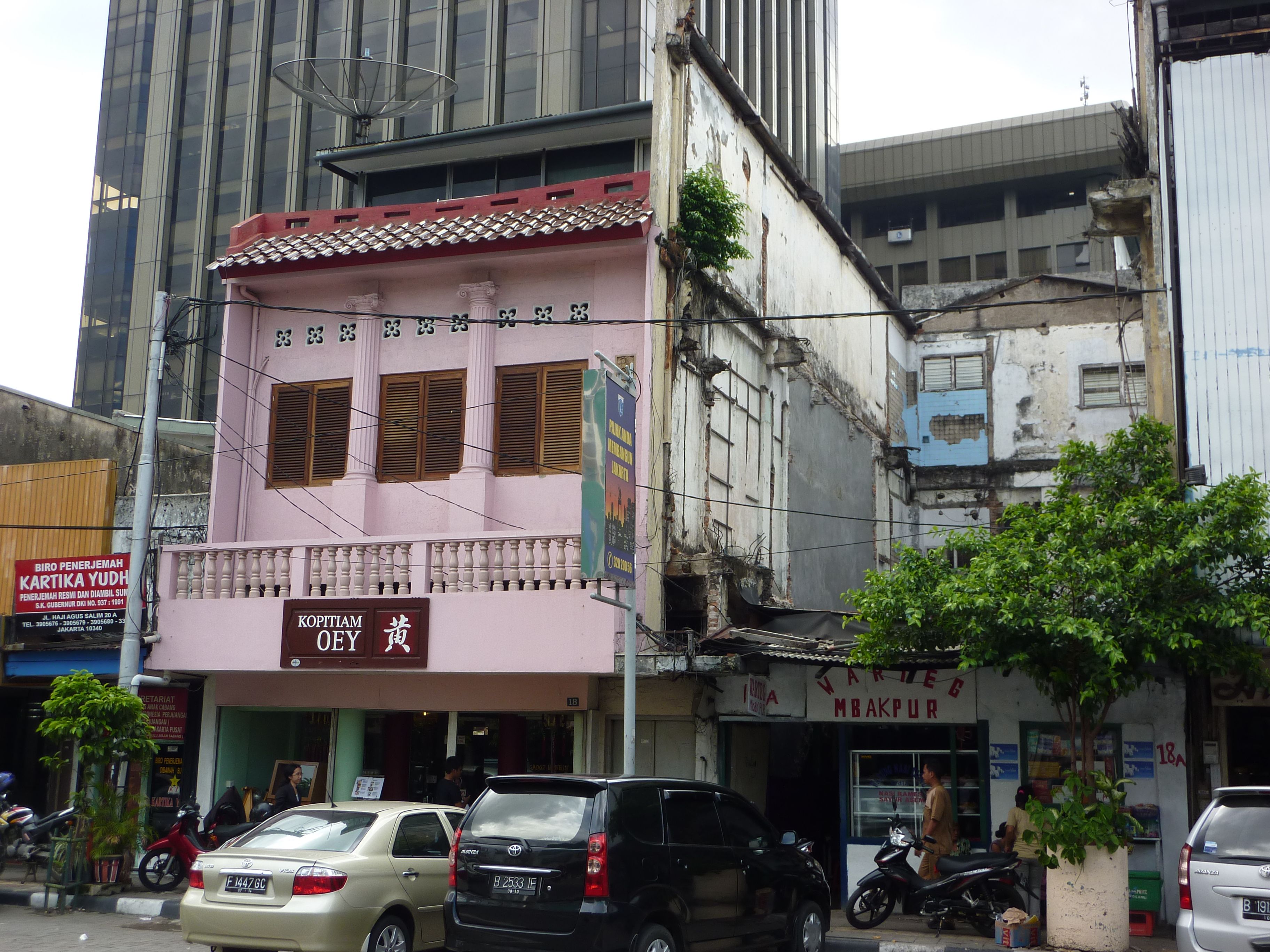
The coffee shop is quite new opening in April 2009 and an establishment that I’d associate with the signs of urban renewal, if not gentrification, although I’m not certain such a concept might be applied here. It resembles an old Peranakan coffee shop. Inside it’s cool, quiet and welcoming. I was immediately drawn to the old Chinese style poster on the walls. They reminded me of Tatiana Pentes’ work expressed in such projects as Strange Cities and Menorah of Fang Bang Lu.,
In Java there’s a great love of song birds. Here the lamp shades are made from bird cages, each covered with a piece of red cloth. It’s very much a contemporary interpretation of the past, but that’s what makes it’s ambience so engaging. One is both offered dreams of the past but confronted with the present, in the décor, service, the menu and the ban on smoking inside.
I fell into conversation with one of the young people working in the coffee shop. Like many young Javanese people he draws on a rich and ancient culture. As a young Muslim his knowledge of Kebudayaan Adat and his syncretic tolerance was refreshing, such a contrast with the cartoon like stereotypical representations of Indonesians, too commonly portrayed in the Australian press.
He directed me to this website Jalansutra,or Silk Road that I’ve only just started exploring.




 Maximos' Blog
Leave a reply to Setting the Stage « En Route Cancel reply