Recently I’ve watched some documentaries on YouTube. I use the term documentary advisedly and prepared this post by way of explanation. The first one to catch my eye was a documentary about the Rats of Tobruk.
During my 1950’s childhood the Rats of Tobruk were feted as an example of heroism and Australian resilience in the face of overwhelming force.
It was German propaganda—specifically propagandist William Joyce (“Lord Haw-Haw”), who used the term ‘Rats’ derisively, and the Australians proudly claimed it.
Surrounded by German forces along a 50-to-60-kilometre front line, the ‘Rats’, comprising the 9th Australian Division, the18th Brigade of the 7th Division, British artillery units, and the 3rd Indian Motor Brigade, withstood the siege from April–November 1941.
Next a watched one about the Kokoda Track which didn’t engage me since I’ve already read much about is and watched numerous documentary treatments include Damian Parer’s iconic work.
We’d Never Seen Men Like This
Then I noticed a ‘documentary’ titled “We’d Never Seen Men Like This” — German Women POWs Meet Australians”. This caught my attention. Its byline read:
May 1945 — 120 German women POWs arrived in Australia expecting brutal treatment. Instead, they encountered something that shattered everything Nazi propaganda had taught them: enemy soldiers who called them “ladies,” fed them better than their own country ever had, and showed them what real strength looks like. This is the incredible true story of German women prisoners at Tatura POW camp who discovered that their captors treated them with more dignity than their own leaders. From Easter egg hunts to abundant meals, these women learned a devastating truth: they’d been on the wrong side all along. Discover how kindness from the enemy broke through years of propaganda and changed these women’s lives forever.
Doubts arise
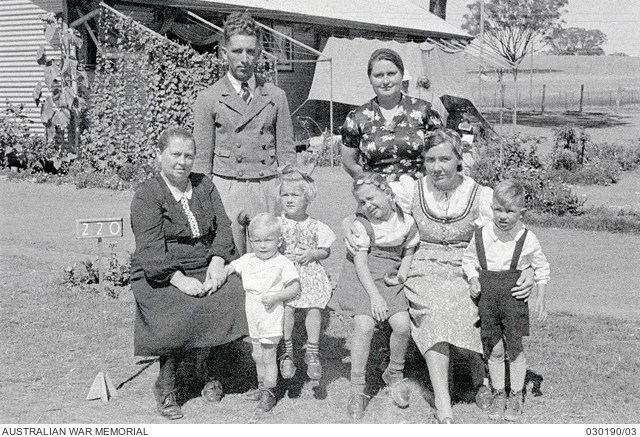
While I could see that some of the static images used were incorrectly identified, I was prepared to run with this given the likely difficulty of finding more reliable resources. It was something quite trivial that aroused my doubts about this documentary’s authenticity, something as simple as the food served at the first evening meal in Tatura prison camp. The commentary was as follows:
The first woman in line held out her plate and watched in disbelief and to the server placed a piece of roasted chicken on it 4 ounces of real meat golden brown and steaming then came potatoes mashed with butter that glistened on top then carrots bright orange and cooked tender then a thick slice of white bread soft and fresh not the hard black bread they had known in Germany. A pat of yellow butter sat beside it . . .
In 1940s Australia chicken was a luxury item. Perhaps it might have appeared on a Christmas menu, but it was not a staple. Indeed, chicken at the time was four times more expensive than red meats like mutton and beef.
The women received much the same food as Australian soldiers. If meat was served, it would have been mutton or beef. At the time with beef sausages were popular.
Questioning the timeline
Singapore was under Japanese occupation until September 1945. So, it would not have been possible for Australian forces to be processing prisoners of war in a holding camp in Singapore in May 1945.
There was a group that arrived in Australia from Singapore in 1940 on the Queen Mary. Most were civilians or Jewish refugees, not military personnel captured after Hitler’s death. The Duntroon was the real ship used in 1945 but its main mission that year was bringing liberated Australian prisoners of war home from Singapore, not shipping German prisoners of war to Australia.
Who were the Internees at Tatura
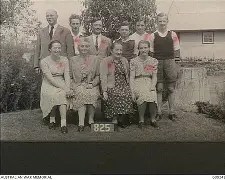
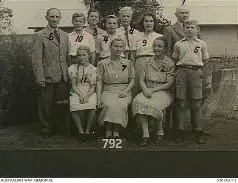
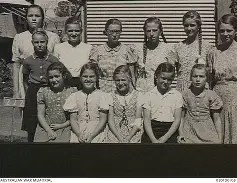
Thousands of people were interned at the Tatura comprising German, Italian, and Japanese civilians and families, as well as prisoners of war from several nations. There were both civilian internees, including families) and POW. Whether or not POWs were interned depended on their perceived security risk.
OIf course there are other plainly invented features of the work. The specific stories of Greta, Ilsa, Freda and Anna are plausible, but these are most likely composite characters. While their experiences make sense their internal monologues are most certainly scripted for the video.
At best I could say that the video is a work of creative non-fiction.
 Maximos' Blog
Leave a comment