
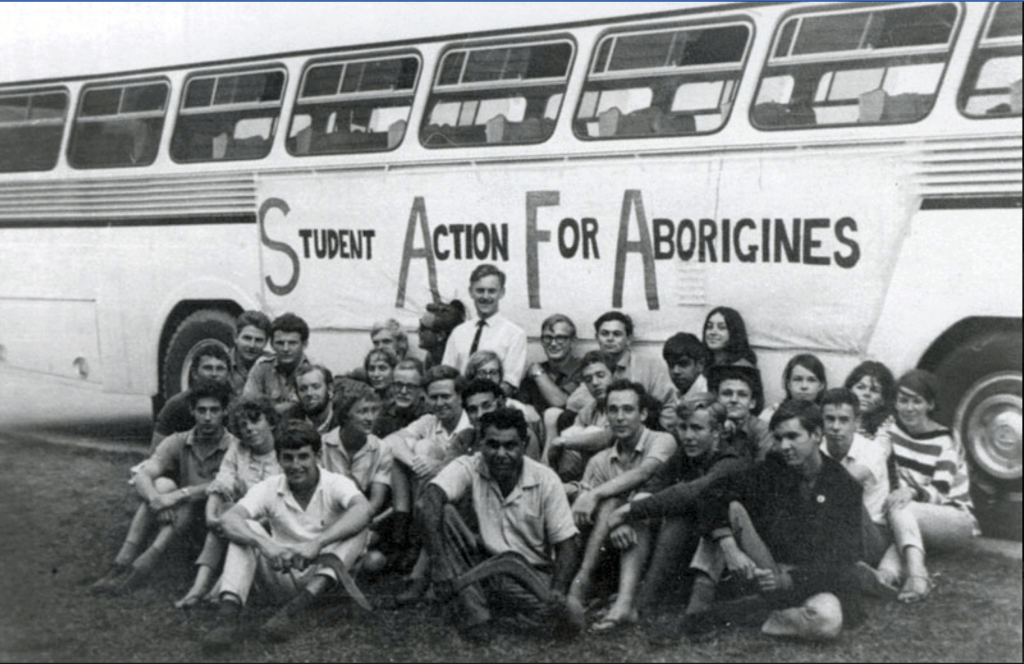
“In 1965, a group of students from the University of Sydney drew national and international attention to the appalling living conditions of Aboriginal people and the racism that was rife in New South Wales country towns. Known as the Freedom Ride, this 15-day bus journey through regional New South Wales would become a defining moment in Australian activism”
From AIATSIS
The following piece was written by my friend Dr Aidan Foy AM who joined the Student Action for Aborigines (SAFA) Freedom Ride 60 years ago this February.
Aidan has already contributed to my blog with his piece The Voice to Parliament, published in September, 2023.
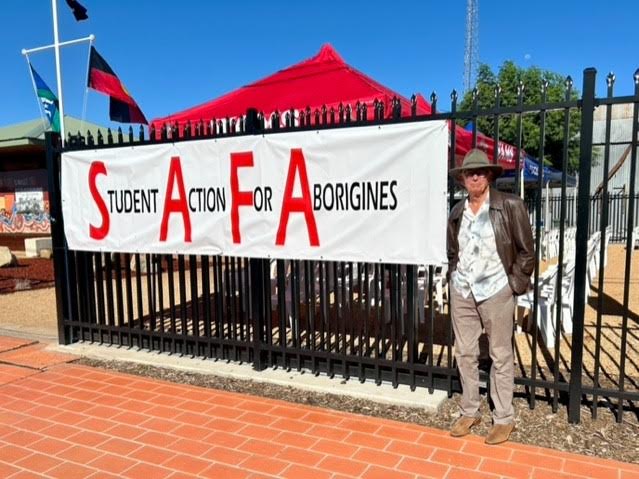
Thoughts re Walgett
In 1965, as an idealistic young man, just turned 18, I joined the Student Action For Aborigines (SAFA) bus tour, now melodramatically called the Freedom Ride. We did a circuit of rural New South Wales, looking at the conditions of Aborigines and staging demonstrations where we found blatant racism, usually shown by various forms of segregation. Walgett was one of the towns we visited, and over the next twelve months, groups of up to four of us re-visited Walgett to help the local Kamilaroi people make their presence felt. I must have decided that Walgett was to be where I would make my contribution, because I went on all of the follow up visits, including the one in August 1965 when we staged a “sit in” at the Luxury Cinema to remove the “colour bar” preventing Aborigines to sit upstairs. After SAFA my involvement in Indigenous matters has been medical, as a specialist in Addiction, Liver disease and Internal Medicine. I gave evidence at the 1988 Royal Commission, did some outreach clinics in Central Australia, and, with colleagues from the Newcastle Mater hospital, ran an outreach service to Moree and Mungindi for eight years. I have only been back to Walgett twice since 1965, passing through a couple of years ago, then for the 60th anniversary of the bus tour last week.
After 60 years, the first impression of the town is disorientating. The old buildings, including the Art Deco movie theatre are all gone, unlike other towns in the region which have restored and maintained their built character. However, there is more green space than I remember, the old courthouse and the Council chambers are still there, re-purposed as a museum and offices for the local history society, and there is a modern coffee shop and an IGA selling fresh food. On reflection, what are missing are the markers of the old “cocky town” in which First Nations people had no place.
I must admit that I was quite unprepared for the events of the commemoration of the bus tour. I envisioned a catch up with old friends, inspection of the commemorative garden, a cup of tea, and a walk around the town. There were five former bus riders, me, Ann Curthoys, Alec Mills, Beth Hansen, and Chris Page. When we heard that the Governor and some senior politicians were coming, it was apparent that it would be a more formal occasion, and a couple of us agreed to make short speeches, but I was still taken by surprise.
Firstly, the garden, on the site of an old Commonwealth Bank building, is modern, well designed and evocative. Large photos of the bus and demonstrations are displayed on a central pavilion which was once the bank’s vault. There are informative plaques all around with places to sit in the shade. The gardens will eventually add colour as they grow. The Governor and politicians spoke about the significance of the Bus Tour and unveiled a blue commemorative plaque on the wall. There were other remembrances of Kamilaroi elders who preceded the events of 1965.
Before we got to the garden, we were asked to lead a short march, so that we could arrive and have a smoking ceremony at the entrance. That was the point at which I nearly lost it. We were asked to lead from about a block away, and as we lined up, it became obvious that every school in Walgett, Collarenebri, and Brewarrina had time off to attend because of the historical importance of the event. Most of the adult population had also turned out. Suddenly, standing in the street where we had been threatened and abused in 1965, there were hundreds of people telling us that what we had done had changed their lives.
As we reached the garden, about 200m away, I found myself shaking hands with the Governor, then with Amy Townsend, Harry Hall’s granddaughter who was running the day’s proceedings. Harry, who was President of the Walgett Aboriginal Progress Association in 1965, had been a key figure at the time of the episode at the cinema. I realised that the little march was not a protest, it was a victory parade. As I took Amy’s hand the enormity of it hit me and I was close to tears.
Of course, it is never as simple as that. It became clear that the focus of the day was firmly on past achievements, not current issues. A small group of marchers started a “Land Rights” chant and were quickly told to desist. One or two people mentioned in quiet conversation that they were upset by division in the community, and when one visitor mentioned to an older man that they were saddened by the failure of the Voice referendum, he responded by saying that he had voted No because he didn’t want “people in Sydney” telling him what to do. I remembered then that the same person had said the same thing in the media during the campaign. Was this wilful ignorance, misinformation or a mix of both? Who knows? A rough analysis of the votes cast suggests that a majority of Walgett’s Indigenous voters voted Yes, with a significant minority voting No.
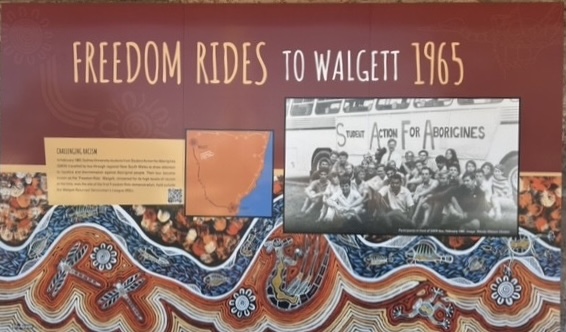
It would be wrong to end on that negative note. Of course, it is impossible to draw any firm conclusions about a place after having spent just one day there, but I left with a great sense of hope. The competence and sophistication of the young, mostly female leadership; the commitment of families to ensure their children have an education, with the involvement of parents and grandparents; and the well run Medical Service, all indicate a community which has control of its affairs and knows where it is going. The Aboriginal Medical Service is the most impressive I have encountered. Early on, they adopted a non-discriminatory policy, welcoming everyone, so that the AMS is an asset for the whole Walgett community, not just First Nations people. They also have an office of Culture and Heritage which is a stroke of genius because identity and pride are important not just for their own sake, but for good physical and mental health. They will arrange guided visits to the commemorative garden which they intend to become a tourist attraction and, I heard, will organise guided trips to the famous Brewarrina fish traps.
At a time when, once again, the world seems dark and hopeless, Walgett shows that the lights are never fully out.


 Maximos' Blog
Leave a comment