This piece was written by my friend Dr Aidan Foy AM.
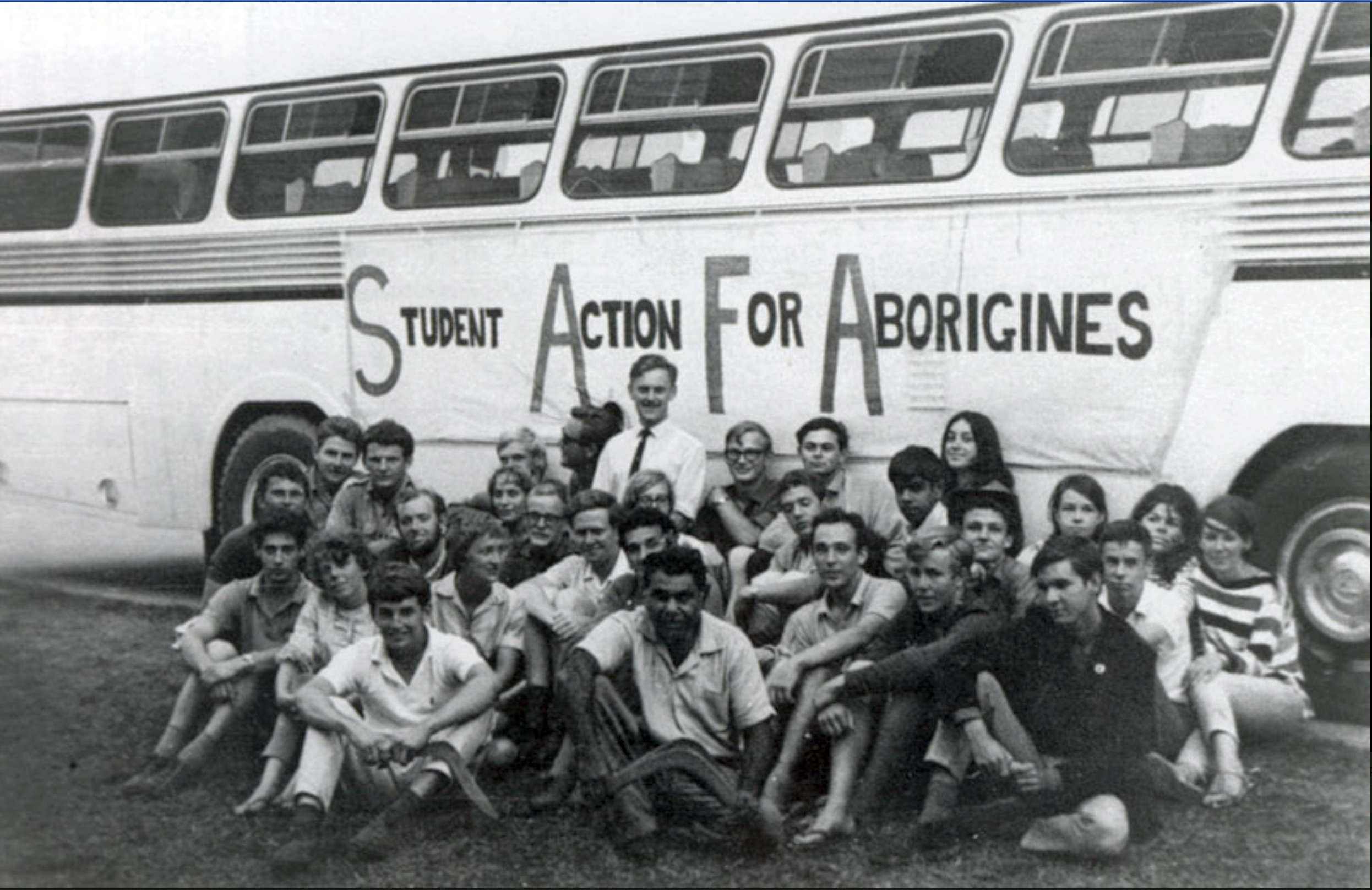
Aidan writes: “In 1967, as a 20 year old member of Student Action For Aborigines (SAFA), I played a very minor role in the campaign for the referendum to change the Constitution.
The question which faced voters in the ballot booths in 1967 read:
“Do you approve the proposed law for the alteration of the Constitution entitled ‘An Act to alter the Constitution so as to omit certain words relating to the people of the Aboriginal race in any state and so that Aboriginals are to be counted in reckoning the population’?”
The proposed law read:
1. This act may be cited as the Constitution Alteration (Aboriginals) 1967.
2. The Constitution is altered by omitting from paragraph(xxvi) the words “other than the Aboriginal race in any State.
3. The Constitution is altered by repealing section 127.
No details
There were no “details”. The 1967 referendum was more far reaching constitutionally than the present one because it resulted in a transfer of jurisdiction from the states to the Commonwealth, led to hundreds of state laws becoming non-functional, a restructuring of state bureaucracies, and by adding another 3% to the census population, a possible recalculation of the arithmetic determining the size and areas of state and federal electorates.
There were dozens of potential questions about the details, but there were good reasons why none were addressed in the campaign. The Australian Constitution is not directive. It simply sets out the parameters of governance. It lays down the rights and responsibilities of the people, the parliament, and the government. It says what areas may be legislated, which must be legislated, and which cannot be legislated. The legislation itself is left to parliament, and the execution of legislation to the duly elected government. In the event of a dispute, the High Court can rule as it did in the Mabo case.
The current campaign
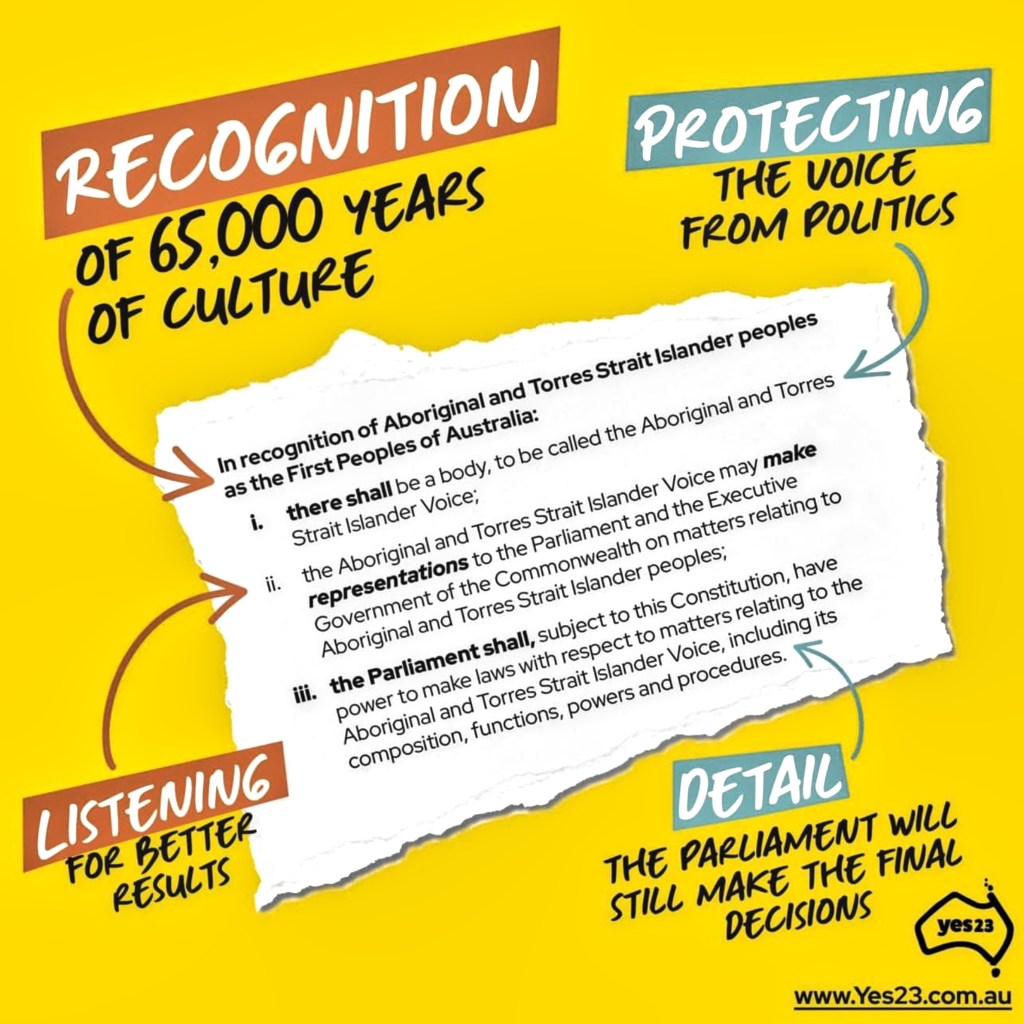
In the current campaign, proponents of a Yes vote have made it clear that, as in 1967, the referendum amendment will not itself set up the mechanism for the Voice, that will be done by the Federal Parliament. The effect of the constitutional change will be that the Voice cannot be abolished without another referendum, so First Nations people will always have a right to be heard on matters affecting them, although the form that takes may vary over time. At all times, the elected parliament will have control.
Some people are anxious about the phrase “executive government” which means the voice can give advice directly to ministers or senior public servants. At the moment, there are hundreds of bodies in Australia which can do this, I have even done it myself. There is no requirement for this advice to be acted on, just listened to. The only advantage the Voice mechanism will have is that it cannot be abolished.
Acknowledging the past
We need to acknowledge the past, honour First Nations culture in the broader Australian culture, and address existing Indigenous disadvantage, marginalisation, and poverty. The third goal needs the Voice to Parliament.
Acknowledging the past should be straightforward. It is, after all, past and cannot be changed. The history of Indigenous people after 1788 is one of dispossession, brutality, mass murder, injustice, and denial of their humanity.
I myself have witnessed boasting from “nice” people that they took away children to give them “a better life” without even the pretence of due process, the children’s mother being apparently irrelevant; I heard second hand from friends of the perpetrators about the rape of Aboriginal girls as a type of sport; I saw the “dog tags” carried by grown men to show police and others that they were no longer subject to the ironically named Aborigine Protection Act. Of course, the story is not totally bleak, no history is, but what happened, happened.
Cultural change
The cultural change has been underway for decades. It is subtle but will be permanent. Changing the names of geographical features, rivers, lakes, plains, and mountains from the names of long dead English aristocrats to more poetic and accurate indigenous names; teaching children the names of the original custodians of the country they are on, and the use of Indigenous ceremony in community and family events. In the visual and performing arts Aboriginal and Torres Strait Island work is everywhere. Indigenous Australia has gone from being invisible to impossible to ignore. This was not the stated intention of the 1967 referendum, but it has been one of the results of it.
Indigenous disadvantage
As a physician, I have seen Indigenous disadvantage firsthand. I have been in rural and remote communities trying to provide a service for people with severe chronic conditions,and have seen poverty, poor health, and poor educational outcomes setting up a cycle of despair leading back to poverty. Add marginalisation, substance abuse and racist attitudes to that and there seems no way out.
Function of the Voice
The only constitutionally mandated function of the Voice will be to advise the Federal Parliament, but as well as exercising their right to be heard, they will also be accepting responsibility for the advice they give. To ensure that the advice is effective there will be a network of constituent bodies at state, local government, and community levels to whom the members of the Voice will be answerable. This will become a resource for advice, information, and negotiation for community leaders, government at all levels, and Indigenous,and non-Indigenous decision makers. Once the system is in place, it will become routine for smaller issues to be resolved locally using the same principles. It will not happen overnight, but eventually we will have First Nations solutions for First Nation problems.
Treaty and sovereignty
Megan Davis, the Human Rights lawyer who has Aboriginal and Pacific Island ancestry and is a member of the Referendum Council has said that a treaty in 2023 cannot be the same as one which might have been signed in 1788. We now have 26 million people living in the most culturally diverse nation on earth, some of whom have themselves fled from cruelty and persecution, and 250 different Aboriginal nations. Any settlement will need to respect the rights of everyone, which will need time, patience, and respectful dialogue. The Uluru Statement from the Heart deals with this brilliantly with the proposal for a Makarrata “coming together after a struggle” which will allow for truth telling and agreement. The Uluru statement includes a definition of Aboriginal sovereignty as a “spiritual notion” which “coexists with the sovereignty of the Crown”. This is also an inspired choice because it validates the original sovereignty of the First Nations without denying that of other Australians.
The Uluru Statement was not imposed on First Nations people by white people or their government. It followed a meticulous and lengthy consultation of First Nations people by a group of their best and brightest which started in 2015, led to the Uluru Statement in 2017 and now, after 8 years, is coming to a vote.
A sense of futility, exhaustion, and bitter recrimination
As a teenage member of SAFA in 1965, I felt that if we could end racism, Indigenous disadvantage, marginalisation, and alienation would gradually disappear. Over 20 years later, when, as a specialist in Addiction Medicine, I gave evidence to the Royal Commission on Black Deaths in Custody, it was clear that although there was goodwill in many quarters, and racism was no longer acceptable in polite society, not much had changed. In the years since, there has been a nationwide effort to close the gap in healthcare, education and economic opportunity and continuing demand from First Nations people for justice. Still the problems remain, and deaths in custody are increasing. I am not sure that racism is even the main issue anymore, it seems to have been replaced by nihilism, or a combination of the two. We are trapped by well-intentioned but poorly focused attempts to help, a sense of futility, exhaustion, and bitter recriminations. All of us, not just First Nations people, need to be freed from this cycle.
A path to a better way
Voting Yes for The Voice will not remedy everything at once, but it will provide a path to a better way and replace despair with hope.
We must replace nihilism with faith. Some Indigenous Christians have condemned non-Indigenous Australians for our indifference to suffering, a lack of compassion, and a failure to see God in the faces of the poor and marginalised. That is a different form of nihilism, expecting nothing to change even after Constitutional change. However, there is another way of thinking. In a recent re-release of his book “Jesus before Christianity” Albert Nolan gives an account of Jesus which addresses two aspects of his ministry which I have always found counter-intuitive; his tendency to keep miracles secret, and his habit of socialising not only with social outcasts but also with ‘sinners’, tax collectors, money lenders and the like, of whom we ourselves would disapprove. For example, St. Matthew was apparently a gambler (according to Caravaggio). Jesus never accepted praise for the miracles, saying “your faith has set you free” to the beneficiary. He did not see himself as the manifestation of a distant God, but a fellow human who had the gift of releasing the power of someone else’s faith. His friendship with sinners, similarly, was driven by his knowledge that God is within us and acts through us, regardless of who we are and what we have done, if we could only realise it and trust in him and one another. Which brings me back to the Voice.
Compassion is useless unless it is accompanied by action. For the first time we have a way forward which has come from First Nations people themselves, and we are called to join them and to trust them as they are willing to trust us. The trilogy of Voice Treaty Truth needs the trilogy of Faith, Hope and Compassion.
The Voice will allow us to develop our faith, trust each other, embrace one another’s humanity, and escape nihilism and despair.
Aidan Foy
Mindaribba August 2023″



 Maximos' Blog
Leave a comment